The client
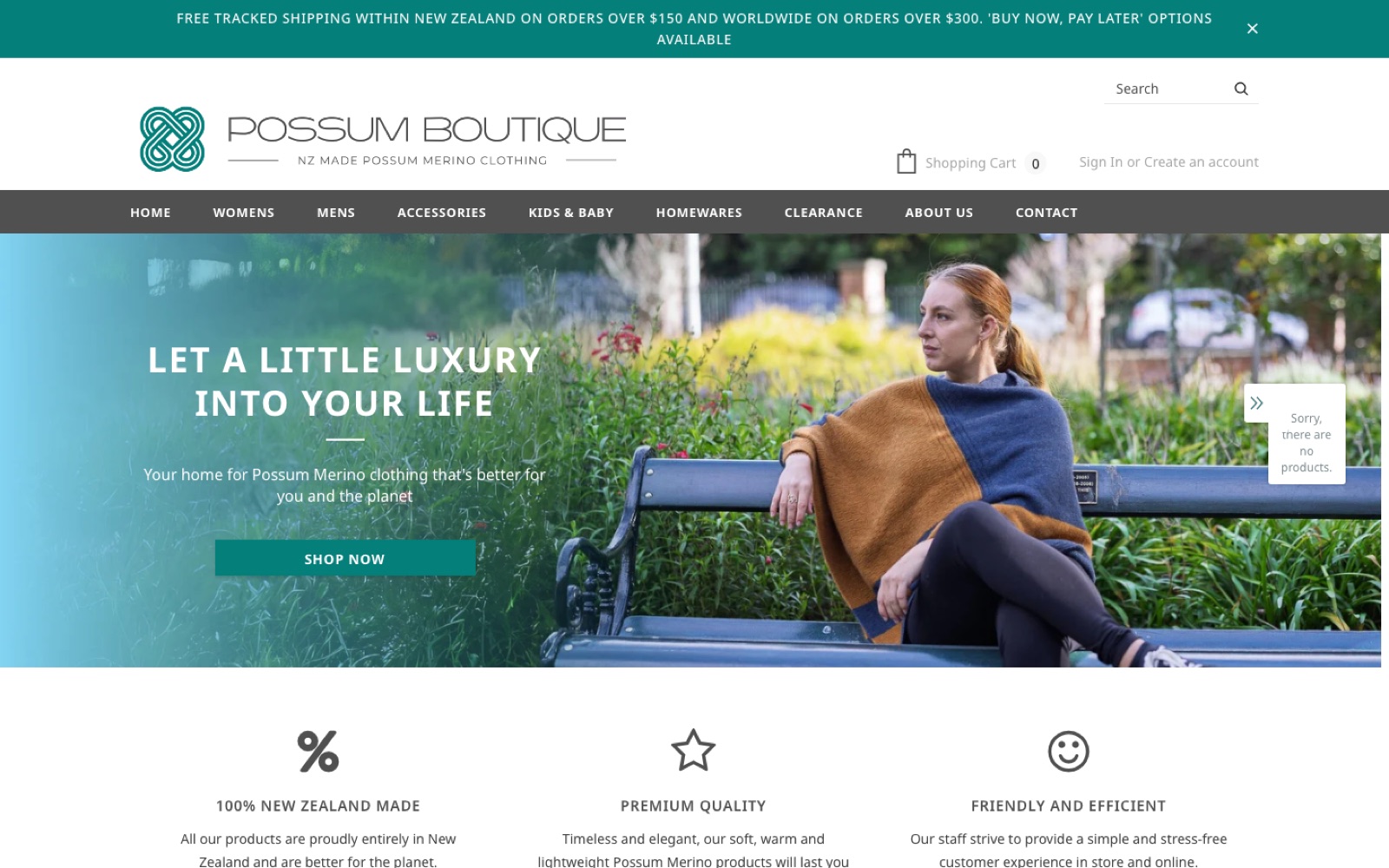
Possum Boutique sells New Zealand made possum merino knitwear to customers here and overseas. Demand is seasonal and the products sell themselves in person. The website was the weak link.
The challenge
The old store was slow, awkward to update and close to invisible in search. Product pages carried no structured data, there was no Google Shopping presence, and organic traffic had been flat for over a year. Winter is when this product sells, so every flat season cost real money.
The brief
Rebuild the store so it loads fast, get it found in Google, and have it selling on launch day rather than a quarter later.
There was no appetite for a long discovery phase and no cash to put down before launch, so the build went on a monthly plan with nothing to pay upfront.
The number we agreed
We agreed the measure before touching anything. Organic traffic was the number, tracked across six months from launch, with PageSpeed as the health check underneath it.
Rankings, impressions and click through rate told us why the number moved. They were not the number. The target went on the reporting dashboard in week one so the client could check it without asking us.
Our approach
The build
The store was rebuilt on Shopify in nine days.
Structured the way people shop
Collections were built around how people actually shop possum merino, by garment and by use, rather than in the order products happened to be entered years ago.
We loaded the products ourselves rather than handing over a spreadsheet, and a photoshoot replaced the supplier images the old store had been using.
Speed
Most of this traffic arrives on a phone, often on mobile data. Every extra second of load time costs customers before they see a product.
The new store launched at 98 on Google PageSpeed and has stayed in that range since.
Google Shopping went live the same day the store did. The product feed and Merchant Centre were set up during the build rather than after it, so the store was capturing buying-intent searches from day one.
The results
Six months after launch, organic traffic was up 300%. The store scored 98 on PageSpeed, Shopping Ads had been selling since day one, and the winter peak converted instead of bouncing.
That was the first six months. The work has carried on since: links every month, articles every month, Shopping campaigns adjusted around the season, and PageSpeed still in the high 90s. Possum Boutique is still a client, which is the part of a case study that usually goes unsaid.
What actually moved the number
Three things, in roughly this order. None of them work alone.
-
1
The rebuild
It cleared the technical drag and gave everything after it a fast, crawlable store with product pages Google could read.
-
2
Link building
25 or more quality links a month, aimed at retail and New Zealand made product sources. This is the slow part, and it is most of why the store ranks in a category where trust decides who wins.
-
3
AI blogging
Articles answering what knitwear buyers search for, published monthly and read by a person before they went live.
None of the three works on its own. A fast store with no authority ranks for its own name and nothing else. Links pointing at a slow site waste what they earn. Articles written for a search engine rather than a buyer bring traffic that leaves again.
Run together for six months, they tripled organic traffic. Shopping Ads paid the bills while that happened, which is what lets a small retailer wait for organic search instead of giving up on it in month two.
What we do for them now
The build was the start of it. The biggest change since is that we are in the shop with a camera every quarter.
Possum merino is a product you have to see moving. Photographed flat on a white background it looks like every other knitwear brand online, which is why the old store's supplier images were doing it no favours. We now run regular photo and video shoots for Possum Boutique, on location and on the models, and the footage feeds three places at once: the product pages, the social calendar, and the Shopping Ads.
Each shoot covers a quarter. We come away with product stills for the store, short vertical video for Instagram and TikTok, and enough b-roll to keep posting through the season without recycling the same three photos. The reels are edited, captioned and scheduled by us, so the boutique is not writing captions at nine at night.
The practical effect is that the store, the ads and the social feed all show the same product in the same light, shot in the same week. That consistency is hard to buy from stock libraries and impossible to fake with supplier images.
Doing this for your store
Possum Boutique is one store with one product line, and your numbers will be your own. What transfers is the order of the work: fix the platform, buy attention while organic search builds, then let content, links and your own photography do the compounding.
The same sequence suits a workshop in Petone shipping nationwide as much as a shopfront on the Kāpiti Coast, or a retailer in Newtown whose customers walk past the door and still check the website before they come in. We have run this play from a Wellington base since 2016, for more than 200 New Zealand businesses.
Where to start
If you sell online, start with Shopify eCommerce and check what the plans cost. If most of your customers live within an hour of you, our Wellington digital marketing page is the better place to begin. Either way you can pay monthly with nothing upfront, or buy the build outright, and the social shoots can be added whenever the content is worth more than the saving.
Organic traffic tripled in the first six months, and they loaded every product for us. Now they turn up with a camera each quarter and we have content for the season without lifting a finger.